One Data Hub (nexyo fabric) per Participant, one rulebook, one operator
Each Participant gets its own Data Hub. It keeps its data, shares it through Offers with Policies, and receives proof of every exchange.
Every Participant keeps its data
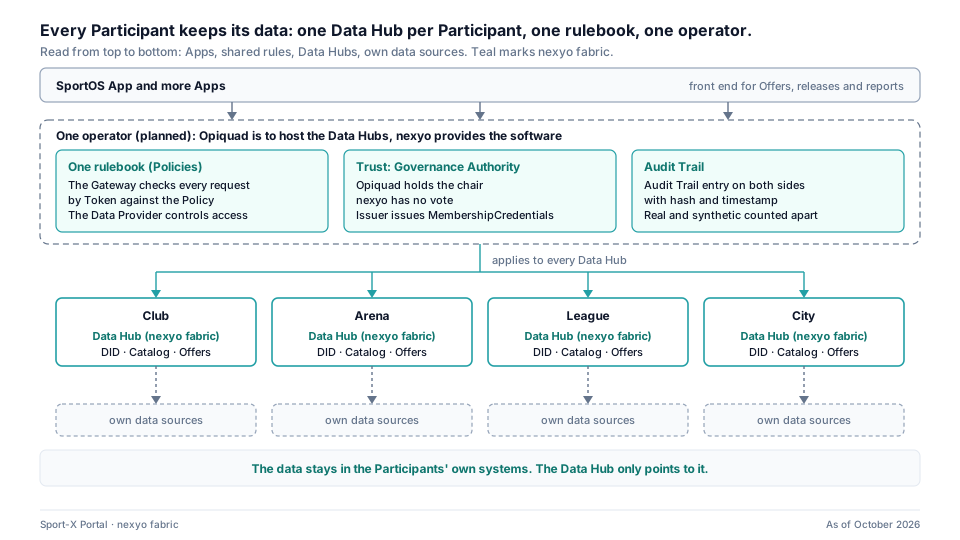
The Data Hub points to your data and does not copy it
Your data stays in your systems: in files, databases, or interfaces. The Data Hub holds only the pointer.
You decide which Resources you publish as an Offer. Each Offer carries a Policy. Other Participants see your Offers in your Catalog and request access.
Opiquad is to host the Data Hubs as operator of the Data Space. The demos run at nexyo today. nexyo provides the software.
Every exchange leaves verifiable proof on both sides
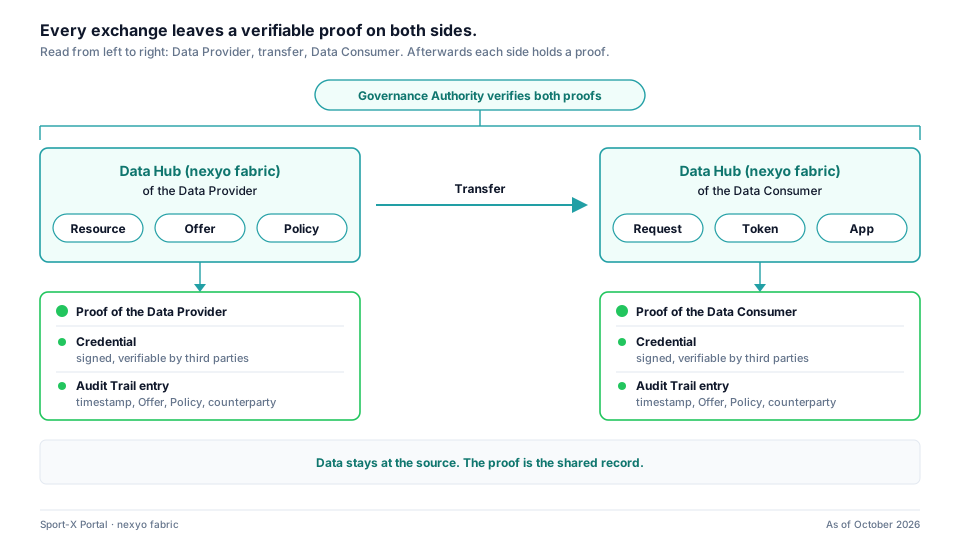
Trust consists of identity, rule, and proof
Trust has three parts. A machine can check all three.
- Identity: Each Participant has a decentralized identity (W3C DID). The Issuer confirms membership with a MembershipCredential. The Decentralized Claims Protocol (DCP) governs the check.
- Rule: A Policy states who may use data and for what purpose. It follows the Dataspace Protocol (DSP) and describes usage rights in ODRL.
- Proof: Every access creates an entry in the Audit Trail on both sides, with a timestamp and a hash.
Five layers carry Sport-X, and each one has a clear job
-
Sources: the data stays with the Participants
Schedules, venue files, ticketing data, and sponsoring data stay in the systems of the Participants. Nobody copies them.
-
Data Hub: each Participant has its own
The Data Hub points to the sources and publishes Offers. It belongs to exactly one Participant.
-
Policies: rules apply per Offer
Policies set the purpose, the aggregation duty, groups of at least 50 people, redistribution, and processing in the EU and EEA. The Data Provider decides.
-
Trust: identity, Credential, and Audit Trail
The Issuer issues Credentials, and a Verifier checks them. The Audit Trail records every exchange.
-
Applications: access runs through familiar interfaces
Clubs and arenas see Offers, approvals, and reports in an application such as SportOS. Access through SportOS is under construction. Until then, the loom web interface serves as the entry point.
Open standards instead of a closed platform
Sport-X builds on open standards:
- IDSA Rulebook: the rulebook of the International Data Spaces Association for Data Spaces
- Dataspace Protocol (DSP): catalog queries, contract negotiation, and the start of a data transfer
- Decentralized Claims Protocol (DCP): exchange and verification of Credentials
- Gaia-X: framework for trust and digital sovereignty
- ODRL: machine-readable usage rules
nexyo will publish the status of the conformance tests for DSP and DCP as soon as it is available.